


My dear brothers and sisters, peace be upon you. Today, we will discuss a topic of immense importance in our daily lives, haram drinks in Islam. Know that every sip you take can either draw you closer to Allah or distance you from Him. Not everything is permissible for us to drink and Allah tells us in the Qur’an…
O you who have believed, eat from the good (pure and lawful) things which We have provided for you and be grateful to Allah if it is [indeed] Him that you worship.” (Surah Al-Baqarah 2:172)
The above verse connects the concepts of consuming what is good, pure, wholesome with gratitude to our Creator. To consume what is pure is an act of thankfulness. Conversely, to consume what is impure or forbidden is a form of ingratitude. It pollutes not only the body but also the heart. It can harden the heart, weaken the soul’s connection to its Lord, and make acts of worship feel heavy and burdensome.
The Messenger of Allah ﷺ warned us about this in a profound hadith. He mentioned a man who travels, raises his hands to the sky, and says, “O Lord, O Lord,” yet:
“His food is haram, his drink is haram, his clothing is haram… so how can his supplication be answered?” (Muslim)
Allāhu Akbar. Even your du‘ā can be blocked because of what you consume. That’s why understanding forbidden drinks in Islam is not a minor issue, it is part of your īmān, your obedience, and your relationship with Allah. The purity of our sustenance is a prerequisite for the purity of our connection with Allah.
In Islam, the word haram simply means that which Allah has strictly forbidden, and the opposite is halal, meaning that which is permissible, pure, and lawful. Before we begin listing specific haram drinks in Islam, we should know that every command and prohibition has a purpose. When you understand the principle, you won’t just follow Islam, you will live it with clarity and conviction.
Halal and haram are not based on culture, opinion, or trends. They are defined by our creator, Allah. So the concept of haram drinks in Islam is not just about avoiding something harmful, it’s about obeying your Creator. Haram is that for which the one who does it may be punished and the one who abstains from it will be rewarded, making it important to follow it. Even, it is part of our worship.
Alcohol and Intoxicants – The Major Haram Drinks in Islam
My dear brothers and sisters, when we speak about haram drinks in Islam, there is one category that stands above all others in clarity, severity, and warning and that is alcohol and all intoxicants. This is not a minor issue. It is from the major prohibitions and sins that carry serious consequences in this life and the next.
This alcohol we are speaking of is the mother of all impurities, the key to all evils, as the Prophet (peace be upon him) named it. It is the substance that, more than any other, has been the cause of personal devastation, family breakdown, and societal decay throughout human history. Our deen, in its infinite wisdom, does not prohibit something without cause. It protects us.
Why Alcohol is Haram in Islam
When Allah and His Messenger prohibit something, the believing man and woman say, “We hear and we obey.” That is the essence of faith. But Allah, in His mercy, also opens our eyes to the wisdom behind His commands, so that our obedience is built on understanding and conviction. Some of the effects of Alcohol are
1. The Spiritual Harm: It Weakens and Destroys Faith
The greatest gift Allah has given us is Iman (faith). And what does alcohol do? It directly attacks this faith. A true believer cannot coexist with intoxication. Our Prophet (peace be upon him) said:
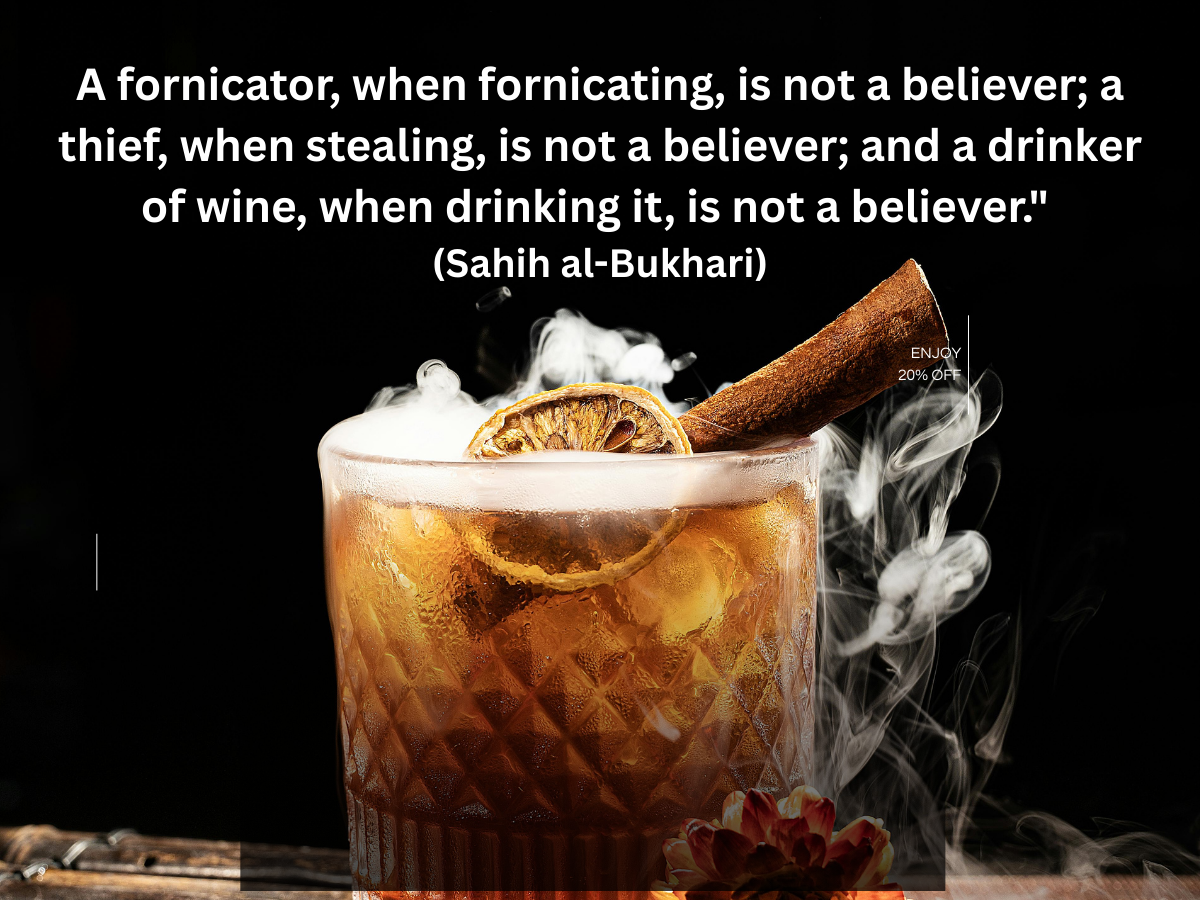
“A fornicator, when fornicating, is not a believer; a thief, when stealing, is not a believer; and a drinker of wine, when drinking it, is not a believer.” (Sahih al-Bukhari) .
This does not mean the person leaves the fold of Islam entirely, wa iyyadhu billah. It means that at the moment of committing that sin, the reality of faith, its light, its sweetness, its protective barrier, leaves his heart. And we can say his faith had decreased. Furthermore, the punishment for this spiritual crime is severe. The Prophet (peace be upon him) warned:
“If a man among my Ummah drinks Khamr, Allah will not accept his Salah for forty days.” (Sunan an-Nasa’i) .
This means he will not receive the full reward of the prayer, even though he is still obligated to perform it.
2. The Social Harm: It Destroys Families and Communities
Allah tells us in the Quran that Shaitan’s goal with intoxicants (Alcohol) is to sow enmity and hatred among you. Allah says:
“Satan only wants to cause between you animosity and hatred through intoxicants and gambling and to avert you from the remembrance of Allah and from prayer. So will you not desist?” (Qur’an, Surah Al-Ma’idah, 5:91) .
- It destroys families: How many wives have been beaten by drunken husbands? How many children have grown up in fear because of a parent’s addiction?
- It destroys communities: Drunk driving kills innocent people. Alcohol-related violence fills our hospitals and prisons. It is a primary factor in countless crimes, from theft to assault to murder.
4. The Health Consequences: It Harms the Body
Our bodies are an amanah (trust) from Allah. We are commanded to take care of them, for they will testify for or against us on the Day of Judgment. Allah says..
“And do not kill yourselves [or one another]. Indeed, Allah is to you ever Merciful.” (Qur’an, Surah An-Nisa, 4:29) .
Scholars of Usool al-Fiqh (principles of Islamic jurisprudence) have established a maxim: “Avoiding harm takes precedence over seeking benefits.” The harm of alcohol to the human body is now medically indisputable. It is a toxin that damages virtually every organ system.
- It attacks the liver, causing cirrhosis and failure.
- It damages the brain, leading to memory loss, cognitive decline, and mental illness.
- It weakens the heart and contributes to high blood pressure and stroke.
- It is linked to numerous cancers.
- It weakens the immune system.
Drinks That Become Haram Due to Intoxication or Ingredients
My dear brothers and sisters, this is where many people become confused when discussing haram drinks in Islam. Not every drink that is forbidden is originally haram. Some drinks begin as halal and pure, but then, through fermentation, chemical changes, or added ingredients, they become part of the forbidden drinks in Islam.
And this is a very important principle, especially in our time, where food and drinks are processed, packaged, and mixed in ways that are not always obvious. So let us break this down clearly, so you can protect yourself and your family with knowledge.
1. Fermented Drinks
One of the most common ways a drink becomes haram is through fermentation. Fermentation is a natural process, but when it leads to intoxication, the rules change completely. Let’s bring it home to our environment here in Nigeria and similar societies.
Common Examples Include:
- Palm wine
- Burukutu
- Ogogoro
- Other locally brewed drinks
2. Drinks Containing Alcohol-Based Additives
There are drinks that may not intoxicate on their own, but they contain alcohol-based ingredients. These are not drinks you consume to get drunk. They are additives, flavourings, or medicines that may contain alcohol as a base or solvent. This is where many Muslims become confused, and where Shaitan loves to cast doubt.
Common Examples:
- Flavour extracts (like vanilla extract). This is mostly used in baking cakes
- Certain soft drinks with alcohol-derived flavouring
- Medicinal syrups (cough syrups, tonics) that contain Alcohol
- Processed beverages with hidden alcohol additives
So what is the ruling here?
If the alcohol is present in a significant amount or contributes to intoxication (even if consumed in large quantities), then it falls under haram drinks in Islam. The evidence is from what our Prophet has clearly stated for us.
“Whatever intoxicates in large amounts, its small amount is forbidden.” [Hasan] – [Narrated by Abu Dāwūd, At-Tirmidhi, Ibn Mājah, and Ahmad] – [Sunan Abi Dawood – 3681]
Types of Alcoholic Drinks Muslims Must Avoid
Now that we understand the principle, let us be clear and practical. When we talk about forbidden drinks in Islam, we are not referring to just one type of alcohol. Every drink that intoxicates, regardless of its name or quantity (small or large), is haram. This includes:
Common Alcoholic Drinks
- Beer
- Wine
- Whiskey
- Vodka
- Gin
- Rum
Local and Traditional Brews
In many societies, including parts of Africa:
- Palm wine
- Burukutu
- Ogogoro
- Pelebe
- Other fermented local drinks
Even if they are called “natural” or “traditional,” once they are intoxicating, they fall under haram drinks in Islam.
Modern Alcoholic Beverages
Today, the industry has evolved, and Shayṭān beautifies things with new names:
- Flavoured alcoholic drinks
- Cocktails
- “Light” alcohol beverages
- Alcohol-infused energy drinks
Don’t be deceived by branding or packaging. The Prophet ﷺ already settled this matter:
“Every intoxicant is khamr, and every khamr is haram.” (Muslim)
Is a Small Amount of Alcohol Still Haram?
This is one of the most common questions today. People say: It’s just a little, it won’t make me drunk… But listen carefully to the words of the Prophet ﷺ:
“Whatever intoxicates in large amounts, then a small amount of it is also forbidden.” (Abu Dawud, authenticated by Al-Albani)
This is a clear and final ruling. If a drink can intoxicate in large quantities, then even a drop is haram
Wisdom Behind the Prohibition of Haram Drinks in Islam
My beloved brothers and sisters, Allah does not prohibit something to burden you. He prohibits it to protect you, elevate you, and preserve what is most valuable in your life. We have identified the haram drinks in Islam, intoxicants, fermented brews, and the modern beverages that we must approach with caution. Some of the wisdom behind these prohibitions, as mentioned by some scholars, includes…
- Protection of the Mind
- Preservation of Health
- Preservation of Society
- Strengthening the worship
My dear brothers and sisters, we have travelled a long and important road together. We have explored the rulings, the evidence, the categories, and the profound wisdom behind the prohibition of haram drinks in Islam. We have seen that this is not a matter of mere restriction, but of divine mercy, a protection for our minds, our bodies, our families, and our eternal souls.
As we conclude, let us remember that the ultimate goal is not simply to avoid what is forbidden. The goal is to draw closer to Allah. The goal is to purify our hearts so that they may become vessels for His light. We ask Allah to make what is halal beloved to us and make what is haram disliked in our hearts. We ask HIm to forgive our shortcomings, accept our efforts, and grant us Jannatul-Firdaws. Aameen
