


Assalaamu alaikum, brothers and sisters in Islam. Not knowing the required age of animals for sacrifice is among the common mistakes that some Muslims fall into during Qurbani. Judging an animal’s eligibility based on its size or appearance rather than its actual age is an error. Therefore, when buying an animal for Udhiyah, it is compulsory that we put the age of sacrificial animals into consideration.
A large, fattened goat or sheep may look “ready” to the eye, but if it hasn’t reached the required age of animals for sacrifice, the Qurbani is not valid in the eyes of Shari’ah. This issue becomes even more critical because the act of worship is at stake. The age of sacrificial animals is clearly defined by our Prophet ﷺ and this is what we have to follow. The Prophet ﷺ said…
“Do not slaughter except a Musinnah (a mature animal), unless it is difficult for you, in which case, sacrifice a Jadha’ah of sheep.” (Sahih Muslim, 1963)
Note that he didn’t say, “Don’t slaughter an animal except what looks like a Musinnah.” He specified the actual maturity, and only in the rare case of hardship, he permits us to slaughter “Jadha’ah” for the case of Sheep only.
What is the difference between Musinnah and Jadha’ah Animal?
In the context of Qurbani (Udhiya), our Prophet Muhammad ﷺ used two important Arabic terms that refer to the maturity and age of sacrificial animals, Musinnah and Jadha’ah. These terms are vital for determining whether your Qurbani animal is valid according to Islamic law.
What is a Musinnah Animal?
A Musinnah animal is one that has reached the required age of animals for sacrifice and full maturity. According to the Sunnah, the Musinnah of animals refers to:
- A sheep or goat that is at least one year old and has entered its second year.
- A cow or ox that is at least two years old and has entered its third year.
- A camel that is at least five years old and has entered its sixth year.
This is the standard requirement for Qurbani animals. These animals are considered physically developed, with sufficient meat and well-matured, reflecting that the age of sacrificial animals has been met.
What is a Jadha’ah Animal?
A Jadha’ah is an animal that has not yet reached full maturity but has grown enough to resemble an adult in size and appearance. The term typically refers to a sheep that is six months old, but appears physically strong, healthy, and mature enough for sacrifice.
This exception of using Jadha’ah animal for Udhiyah was allowed by the Prophet ﷺ only in the case of Sheep when it is hard to get an animal of the required age of animals for sacrifice, which we have mentioned in the Musinnah. The Prophet ﷺ said..
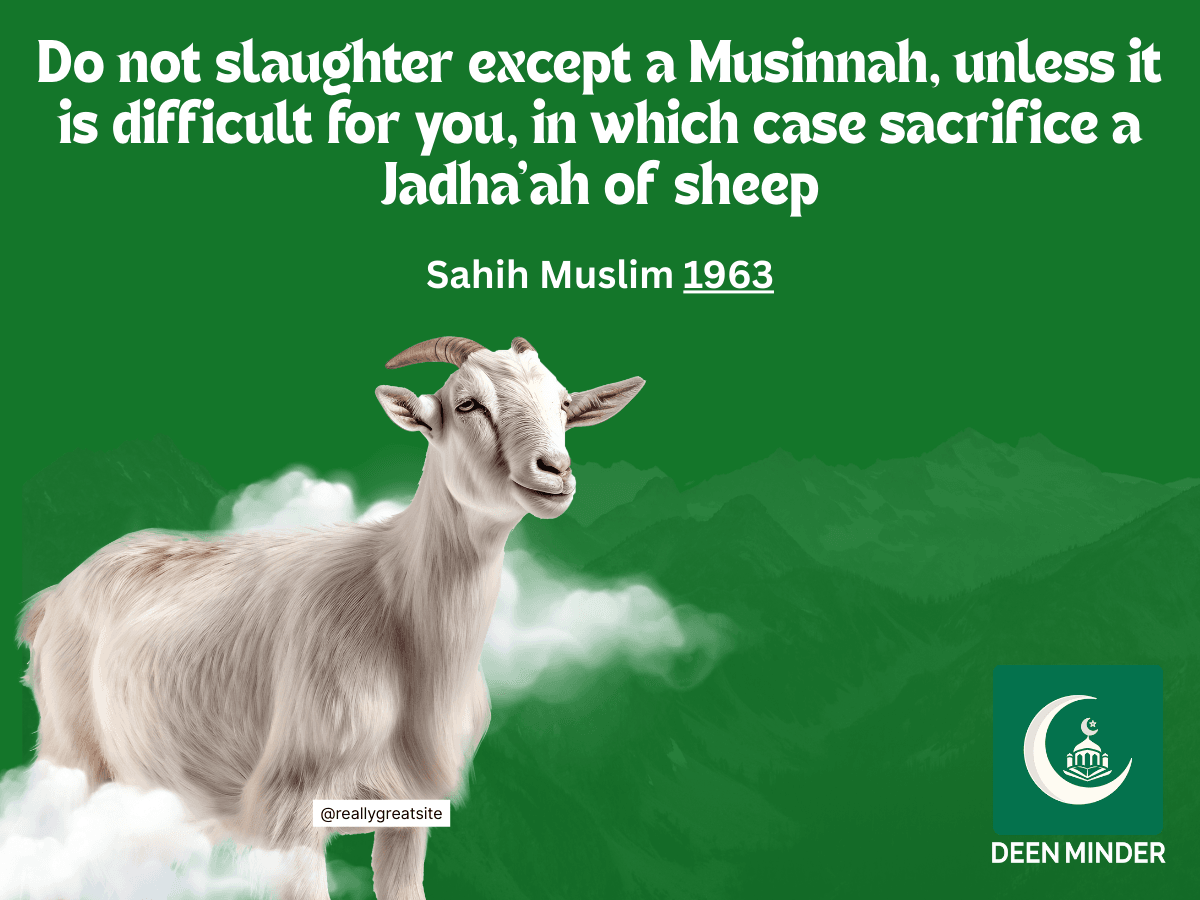
Sacrifice only a grown-up animal (Muhsinnah), unless it is difficult for you, in which case sacrifice a ram Jadha (of even less than a year, but more than six months’ age).
(Sahih Muslim, 1963)
So, while the Musinnah is the norm, the Jadha’ah is a permitted exception only for sheep, not for goats, cows, or camels.
What is the required age of Animals for sacrifice? Age of Sacrificial Animals!
One of the most overlooked conditions of Udhiyah is the age of sacrificial animals, yet it’s one of the most important to consider to make it an accepted act of worship. Following the Sunnah means doing things exactly as the Prophet ﷺ taught us. Offering an animal that doesn’t meet the required age of animals for sacrifice invalidates the Qurbani, no matter how expensive or large the animal may be.
The required age of animals for sacrifice is clearly defined in Islam. Now let’s discuss them one after the other now so that we can know the required age of sacrificial animals accepted by Shari’ah.
1. Camel
The minimum age requirement for a camel is at least 5 years old and entering the sixth year. Camels mature more slowly than other animals, and they have the highest required age of animals for sacrifice. This is because their size, strength, and lifespan demand a longer growth period before they can be considered Musinnah. That is, camels live longer, so their maturity takes time.
In local and international markets, camels are often priced high and come with less visible signs of aging. That’s why it’s even more critical to verify proper documentation when purchasing one for Udhiya.
2. Cow
The minimum age requirement for a cow is at least 2 years old and entering the third year. Cows are classified as Musinnah once they complete two full years. Anything younger than that, even by a few months, is not acceptable for Udhiya.
Many people, especially in local livestock markets, are misled by sellers who claim the cow is “almost two,” especially when it has been fattened. But Islam isn’t based on assumptions, it’s based on clear criteria. So when you’re planning to sacrifice a cow, it is advisable to verify that it has completed 2 full years. Don’t just compromise based on size or market pressure.
3. Goat and Sheep
The minimum age requirement for a goat and sheep is at least 1 year old (Musinnah). The only exception is for Sheep and with the condition that, after being hard to buy or get animals of the required age for sacrifice, then the exception is to get a sheep of about 6 months old or more, and big in size too.
The Prophet ﷺ made this allowance only for sheep, not goats, camels or cows when he said:
Sacrifice only a grown-up animal (Muhsinnah), unless it is difficult for you, in which case sacrifice a ram Jadha (of even less than a year, but more than six months’ age). (Sahih Muslim, 1963)
We have already explained that Jadha’ah sheep refers to a six-month-old lamb that appears physically mature, meaning it looks like it’s one year old in size and health. Scholars have confirmed that this exception is only valid when no Musinnah is available.
How to confirm the age of sacrificial animals
- Teeth examination (a method used by professionals to check age).
- Government or veterinary birth records, especially if you’re buying from a commercial farm.
- Trustworthy sellers who understand and respect the Islamic rulings.
As Muslims, we have to be more conscious of anything pertaining to our worship. We should try to avoid the common mistakes that others fall into during Qurbani by judging an animal’s eligibility based on its size or appearance rather than its actual age. A large, fattened goat or sheep may look “ready” to the eye, but if it hasn’t reached the required age of animals for sacrifice, the Qurbani is not valid in the eyes of Shari’ah.
Summary table of Qurbani animal age requirements
Understanding the required age of animals for sacrifice is not just a technical detail, it’s a Shari’ah obligation. To make this easier for you to remember and implement, here’s a quick summary table outlining the Age of Sacrificial animals for each permissible species according to the authentic Sunnah of our Prophet Muhammad ﷺ and scholarly consensus.
| Animal | Minimum Age | Exceptions |
|---|---|---|
| Sheep | 1 year | ✅ 6 months if it appears mature, based on the Hadith of our Prophet ﷺ that we have cited. |
| Goat | 1 year | ❌ No exception, must be at least one full year |
| Cow | 2 years | ❌ No exception, must have completed two full years |
| Camel | 5 years | ❌ No exception, must be at least five years old |
Other things to check for in your Udhiya Animals
While understanding the required age of animals for sacrifice is essential, there are some other vital conditions that determine whether the Qurbani (Udhiya) is valid in the sight of Allah or not. To offer a truly accepted sacrifice, you must ensure your Qurbani animal fulfills all the Islamic conditions, like the age of sacrificial animals, physical health, proper timing, and others, which we are going to mention now.
1. The Animal must be free from major defects
The Prophet Muhammad ﷺ strictly prohibited sacrificing animals with noticeable defects. This includes animals that are:
- One-eyed or blind
- Lame and unable to walk properly
- Sick with a visible illness
- Severely emaciated or weak
- Missing ears or horns from birth (or completely severed)
The Prophet ﷺ said:
“Four types of animals are not permissible for sacrifice: the one-eyed with a clearly visible defect, the sick with a clearly visible illness, the lame with a clear limp, and the extremely thin one that has no marrow in its bones.” (Reported in Abu Dawood, Sahih by Al-Albani)
These conditions ensure the Qurbani is an act of honor, not negligence. Islam teaches us to give the best to Allah, not leftovers or weak offerings.
2. The Animal must be rightfully owned or bought (Not stolen)
Ownership is a fundamental requirement. You cannot sacrifice an animal you don’t lawfully own. That means:
- It should not be stolen
- It should not be borrowed
- If it’s a gift, the animal becomes yours and you can use this for sacrifice
3. The sacrifice must be performed within the appointed time
The time for slaughtering the animals for sacrifice was legislated by our Prophet ﷺ. Even if your animal meets the age of sacrificial animals and is in perfect health, sacrificing it before Eid Al Adha makes it invalid. The proper time begins after the Eid prayer on the 10th of Dhul-Hijjah and continues until sunset on the 13th of Dhul-Hijjah. The Prophet ﷺ said..
“Whoever slaughters before the prayer, let him slaughter another in its place.” (Sahih al-Bukhari)
So, make sure the act is done after the Eid prayer, not just after sunrise, and preferably by someone who understands the rulings.
Dear reader, by now you’ve understood that Qurbani is not a mere tradition or yearly custom, but a sacred act of worship, rooted in the legacy of Prophet Ibrahim (peace be upon him), upheld by our beloved Prophet Muhammad ﷺ, and bound by divine conditions. One of the most overlooked yet crucial conditions is the required age of animals for sacrifice that we must consider.
Let this guide be a reminder that Allah is not in need of meat or blood. He only desires your sincerity and your obedience to follow His commands precisely. Sacrificing an animal that doesn’t meet the minimum age or is defective, stolen, or slaughtered before Eid will render the entire act invalid. And how tragic would it be to exert the effort, spend the money, and yet walk away with nothing in the hereafter due to negligence?
Allah says:
Their meat will not reach Allah, nor will their blood, but what reaches Him is piety from you. Thus have We subjected them to you that you may glorify Allah for that [to] which He has guided you; and give good tidings to the doers of good. (Q 22:37)
The age of sacrificial animals isn’t just a number. It’s a symbol of sincerity, obedience, and devotion. It reflects your willingness to submit to Allah and His Messenger’s law over culture. In this year’s Eid al-Adha, let your sacrifice truly count, not only in your community by making them to see that you slaughter an animal, but let it count in the sight of Allah by following all the requirements and conditions.
We ask You, Ya Allah, to accept our sacrifices as You accepted from Prophet Ibrahim and Isma’eel. Grant us knowledge that leads to accepted worship. Purify our intentions. Make our Qurbani sincere, Sunnah-compliant, and pleasing to You. Do not let ignorance or negligence rob us of reward. Aameen.
