


Assalaamu alaykum wa rahmatullahi wa barakatuh, my brothers and sisters. We are going to reflect on a matter that touches every human, sickness. When our loved one is unwell, our hearts ache, and we yearn to do something, anything to ease their pain. In Islam, one of the most powerful actions we can take is to make dua for the sick. The Prophet Muhammad (ﷺ) taught us some dua when visiting the sick.
Sickness is one of the many trials that Allah places in our lives to test our patience, faith, and reliance upon Him. It is a reminder of our vulnerability and the need to turn to Allah in times of difficulty. Allah says in the Quran:
“And We will surely test you with something of fear and hunger and loss of wealth and lives and fruits. But give good tidings to the patient, those who, when afflicted with calamity, say, ‘Indeed we belong to Allah , and indeed to Him we will return.’ Those are the ones upon whom are blessings from their Lord and mercy, and it is those who are the [rightly] guided.” Quran (2:155-157)
It is a reminder of our fragility, a call to return to Him. Islam teaches us how to navigate these times, emphasizing both practical measures and the immense power of prayer, especially making dua for the sick.
Islam also teaches us that this illness is not merely a hardship upon us but also a means of purification and elevation in status in as much as one is still a believer. The Prophet Muhammad (ﷺ) reassured us that suffering, whether in the form of illness or discomfort, serves as an expiation for sins. He said:
“No fatigue, nor disease, nor sorrow, nor sadness, nor hurt, nor distress befalls a Muslim, even if it were the prick he receives from a thorn, but that Allah expiates some of his sins for that.” (Sahih al-Bukhari, 5641, 5642)
This reminds us that every pain we endure, no matter how small in as much as we are still a believer, it will be a means of earning Allah’s forgiveness and mercy. However, as believers, our role is not only to be patient in times of trials but also to seek medical help and pray for Allah to remove the pain and suffering.
Making dua when visiting the sick is one of the rights of a Muslim upon another Muslim which we should adhere to. There are a lot of specific dua for the sick which our Prophet ﷺ taught us to recite when we visit the sick ones.
In shaa Allah, we are going to explore three recommended duas for the sick, as taught by our Prophet (ﷺ). These duas are not just words; they are a means of invoking Allah’s mercy and blessings upon the one who is ill.
#1 Dua when visiting the sick ones
This is one of the simple and yet powerful dua for the sick ones. It goes thus:
لَا بَأْسَ طَهُورٌ إِنْ شَاءَ اللَّهُ
La ba’sa, tahurun in sha’a Allah.
“No worries, it will be a purification (from sins), In Shaa Allah.”
The prophet when visiting the patient, he used to say the above prayer. Sahih al-Bukhari, 3616
Making this dua when visiting the sick ones serves as a beautiful reminder that sickness is not merely a hardship but also a means of purification from sins. It instills hope in the heart of the ill person, reassuring them that their suffering is not in vain but rather an opportunity for spiritual cleansing and drawing closer to Allah.
#1 Dua for the sick ones
This dua for the sick is one of the practise of our Prophet (ﷺ) which he used to treat some of his wives by passing his right hand over the place of ailment and used to say:
اللَّهُمَّ رَبَّ النَّاسِ أَذْهِبِ الْبَاسَ، اشْفِهِ وَأَنْتَ الشَّافِي، لاَ شِفَاءَ إِلاَّ شِفَاؤُكَ، شِفَاءً لاَ يُغَادِرُ سَقَمًا
Allahumma Rabban-nas, adhhib al-ba’sa, washfi anta ash-Shafi, la shifa’a illa shifa’uk, shifa’an la yughadiru saqama).
“O Allah, Lord of the people, remove the hardship. Grant cure, for You are the Healer. There is no cure except Your cure. Grant a cure that leaves no illness behind.
Sahih al-Bukhari, 5743
Making this dua for the sick ones brings comfort by reminding the sick that their healing is in the hands of the Most Powerful, and we are calling Him by his beautiful name Ash-Shafi(The Healer), asking for a complete cure that leaves no trace of illness. This strengthens our faith and reliance on Him that medical treatments are merely tools, while total recovery is in His hands.
#3 Dua for the sick ones
Another authentic dua when visiting the sick ones is that our Prophet recommended us to say Seven Times and if we say it other than the time of death, Allah will surely heal the person.

أَسْأَلُ اللَّهَ الْعَظِيمَ رَبَّ الْعَرْشِ الْعَظِيمِ أَنْ يَشْفِيَكَ
As’alullah al-‘Azheem, Rabbal ‘Arshil ‘Azheem, an yashfiyak.
“I ask Allah, the Magnificent, Lord of the Magnificent Throne, to heal you.”
Jami` at-Tirmidhi, 2083
Prophet Muhammad (ﷺ) mentioned that if this dua is recited seven times for a sick person, Allah will grant them healing unless if death has already been decreed for them at that moment. The reference to Rabbal ‘Arshil ‘Azheem (Lord of the Magnificent Throne) indicates Allah’s supreme authority and power over all things, reinforcing the belief that no illness is beyond His ability to cure.
#4 Dua when visiting the sick ones
This is another authentic dua when visiting the sick ones which our Prophet recommended that we say to our sick brother when we visit him.
اللَّهُمَّ اشْفِ عَبْدَكَ يَنْكَأُ لَكَ عَدُوًّا أَوْ يَمْشِي لَكَ إِلَى جَنَازَةٍ
Allahumma ishfi ‘abdaka yankau laka ‘aduwwan aw yamshi laka ila janazah
“O Allah, cure Your servant, who may then wreak havoc on an enemy for Your sake, or walk at a funeral for Your sake.
Sunan Abi Dawud, 3107
Narrated Abdullah ibn Amr ibn al-‘As that the Prophet (ﷺ) said: When a man comes to visit a sick person, he should say: O Allah, cure Your servant, who may then wreak havoc on an enemy for Your sake, or walk at a funeral for Your sake.
This dua for the sick ones is like a plea for Allah to grant this person recovery and allow him to serve Him more on earth.
The Importance of Making Dua for the Sick in Islam
Making dua for the sick ones is one of the greatest acts of kindness and mercy in Islam. It reflects love, care, and genuine concern for the well-being of others. The Prophet Muhammad (ﷺ) mentioned the importance of making supplications for those who are ill, as it not only provides comfort but also brings immense rewards.
Making dua when visiting the sick ones is not only beneficial for the one who is ill but also for the one who makes the supplication. When we pray for someone else’s healing, we are also praying to Allah to grant us well-being too.
The Prophet (ﷺ) said, “The dua of a Muslim for his brother in his absence is answered. An angel is appointed to his side, and whenever he makes a good dua for his brother, the angel says, ‘Ameen, and may you also have the same.’” (Sahih Muslim).
This hadith shows that when we make dua when visiting the sick ones, we are also benefiting ourselves. Our prayers are answered, and we are rewarded for our kindness and sincerity.
Visiting and making dua for the sick ones is also one of the rights that our fellow Muslims owe us and fulfilling this right also fosters a great deal of love and unity in Islam. Islam teaches that every believer is connected like a single body, and when one part is in pain, the entire body feels it. The Prophet (ﷺ) said:
“The believers, in their mutual love, mercy, and compassion, are like a single body: when one limb suffers, the whole body responds with sleeplessness and fever. (Sahih Muslim – 2586)
Making dua when visiting the sick ones is a way to show compassion, strengthen our faith, and seek Allah’s mercy for those who are suffering. As Muslims, we should never underestimate the power of dua. Whether it is a simple prayer for healing or a heartfelt plea for relief, our supplications can bring comfort and healing to those in need.
Making dua for the sick ones demonstrates our concern for the well-being of our fellow Muslims and reflects the empathy that lies at the heart of our faith. When we make dua for someone who is unwell, we are essentially saying, “O Allah, I care for this person, and I know that You are the ultimate Healer. I implore You to grant them relief, recovery, and strength.”
What is the Reward of Visiting and Making Dua for the Sick Ones
Making dua when visiting the sick is one of the most virtuous acts in Islam. It is not only a Sunnah of the Prophet Muhammad (ﷺ) but also a means of earning immense rewards from Allah (SWT). This act of kindness reflects the compassion and unity of the Muslim community, and it brings blessings to both the visitor and the one who is ill. Let us explore the rewards of visiting the sick and making dua for them.
1. A Fulfillment of the Rights of a Muslim
The Prophet Muhammad (ﷺ) mentioned that visiting the sick is one of the fundamental rights Muslims have over one another. He said:
“The rights of one Muslim over another are five: returning greetings, visiting the sick, attending funerals, accepting invitations, and responding to those who sneeze.” (Sahih al-Bukhari)
By fulfilling this right, we strengthen the bonds of brotherhood in Islam. It is a way to show empathy and solidarity, reminding the sick person that they are not alone in their struggle.
2. A Means of Gaining Allah’s Mercy
Visiting the sick and making dua for them is an act of mercy, and Allah rewards those who show mercy to others. The Prophet (ﷺ) said:
If a man visits his Muslim brother when he is sick, he is walking amongst the fruits of Paradise until he sits down, and when he sits down he is covered with mercy. (Musnad Ahmad, 612)
This is a beautiful reminder that every step we take to visit the sick is recorded as a good deed, and it brings us closer to Allah’s mercy and Paradise.
3. A Form of Sadaqah (Charity)
The Prophet (ﷺ) taught us that every good deed is a form of charity likewise visiting our sick brother, it will be recorded for us as a good deed. He said:
“Every good deed is charity. Indeed, among the good deeds is meeting your brother with a cheerful face and pouring water from your bucket into your brother’s vessel.” (Tirmidhi)
When we visit the sick and make dua for them, we are performing an act of charity. This includes the emotional support we provide, the kind words we speak, and the prayers we offer. Such acts of kindness are a means of purifying our hearts and earning Allah’s pleasure.
4. A Way to Expiate our Sins
Visiting and making dua for the sick ones can also serve as a means of expiating our sins. The Prophet (ﷺ) said:
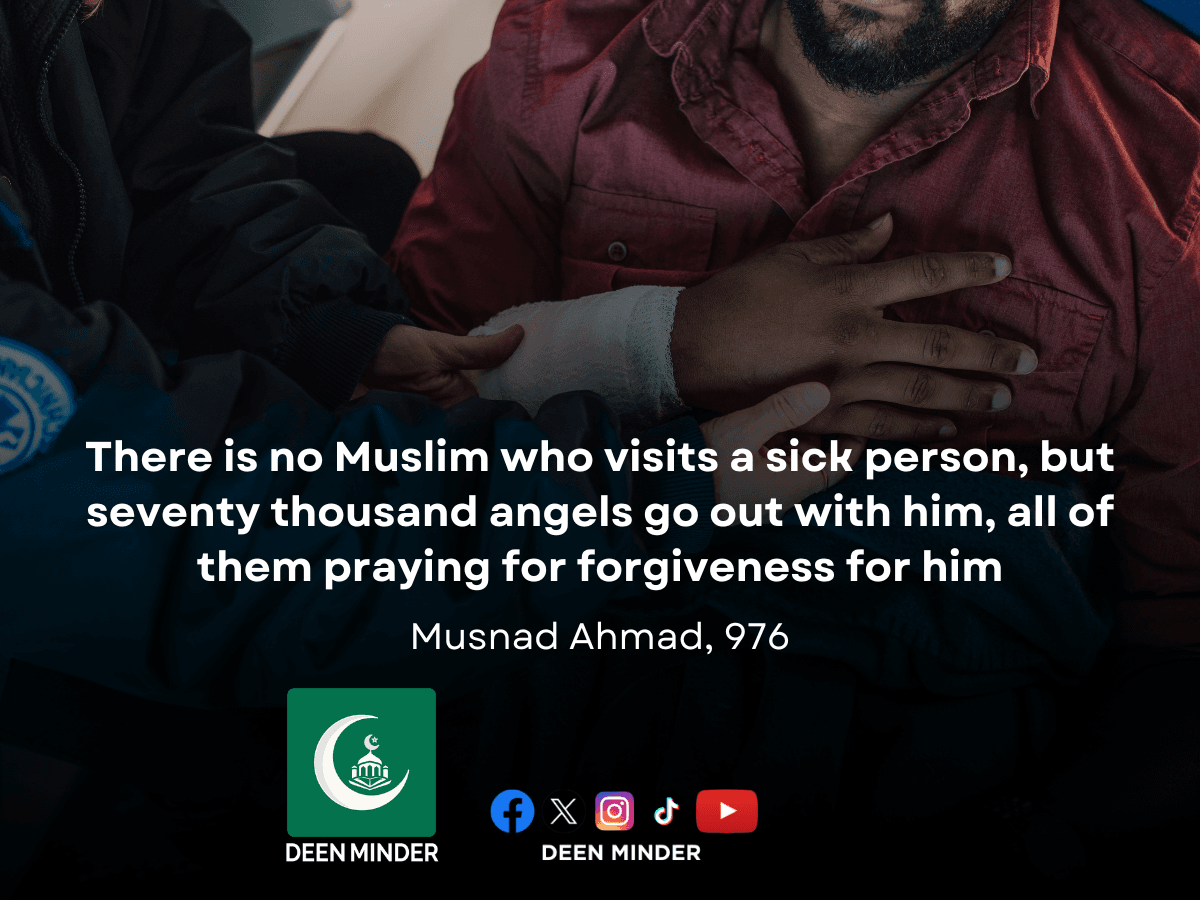
“There is no Muslim who visits a sick person, but seventy thousand angels go out with him, all of them praying for forgiveness for him. If he went out in the morning [they continued to do that] until evening comes, and he will have a garden in Paradise. If he goes out in the evening, seventy thousand angels go out with him, all of them praying for forgiveness for him until morning comes, and he will have a garden in Paradise.”
Musnad Ahmad, 976
This hadith shows that visiting and making dua for the sick ones will not only be a source of blessings but also a way to earn forgiveness and a place in Paradise. The angels themselves will be praying for the visitor, and their supplications are a means of cleansing our sins.
5. A Means of Reviving the Prophet’s Sunnah
The Prophet Muhammad (ﷺ) set a perfect example of compassion and care for the sick. He would visit his companions when they fell ill, make dua for them, and comfort them with kind words. By following his example, we are not only earning rewards but also reviving his Sunnah. The Prophet (ﷺ) said:
“Know that whoever revives a tradition from my Sunnah if it has died out after me, he will have a reward like those who act upon it without diminishing any of their rewards.
Sunan al-Tirmidhī 2677
6. A Means of Earning Allah’s Blessing on the Day of Judgment
Beyond the worldly rewards, visiting the sick also brings blessings in the Hereafter. The Prophet (ﷺ) narrated in a hadith Qudsi that Allah will say on the Day of Judgment:
“O son of Adam, I was sick, but you did not visit Me.” The person will say, “O Lord, how could I visit You when You are the Lord of the worlds?” Allah will reply, “Did you not know that My servant was sick, and you did not visit him? Had you visited him, you would have found Me there.” (Sahih Muslim 2569).
This narration shows that by visiting and making dua for the sick ones, it draws one closer to Allah and earns His pleasure on the day of Judgment. It reminds us that acts of kindness toward others are, in reality, acts of devotion to Allah, and they hold great weight on the Day of Judgment.
Visiting and making dua for the sick ones is a powerful reminder that we are all part of a larger Ummah, bound together by the ties of faith and compassion. Let us strive to follow the example of our Prophet (ﷺ) and make it a habit to visit the sick, comfort them, and pray for their recovery.
We ask Allah, the Most Merciful, to grant complete Shifa (healing) to all those who are suffering from illness and pain. O Allah, You are the Healer, there is no cure except Your cure, grant them a cure that leaves no illness behind. Aameen.
