


As Muslims, whenever we hear the sound of thunder, we should know that these moments are not random. They are meaningful. They are signs from Allah meant to awaken the heart, shake the heedless soul, and turn us back to Him. So, what is the dua for thunder that our beloved Prophet Muhammad used to say? Before we dive into the dua upon hearing thunder, let’s know what Allah and His Prophet ﷺ said about thunder.
Before we rush to memorise the dua for Thunder, let’s try to learn the wisdom in the sound we hear from the thunder. The thunder is not just a weather event. The lightning is not merely a flash of electricity. For us believers, every rumble in the sky is a verse from the book of Allah’s creation. Allah says in Surah ar-Ra‘d, the very chapter named after this phenomenon, that…
“And the thunder glorifies His praise, and the angels [as well] out of fear of Him.” (Surah ar-Ra‘d, 13:13)
This means that the thunder, that booming, cracking, terrifying sound that can make your heart leap into your throat, is not some chaotic, meaningless noise. It is not a random discharge of energy with no purpose beyond physics. It is tasbeeh. It is glorification. It is worship. And this is the beauty of Islam: it doesn’t leave you lost in such moments. It gives us an explanation and wisdom behind it.
Everything that exists praises Allah. The heavens and the earth, the mountains and the seas, the birds in the air and the fish in the water, all of them are in a state of tasbeeh. The difference is that we do not understand their glorification, as Allah said,
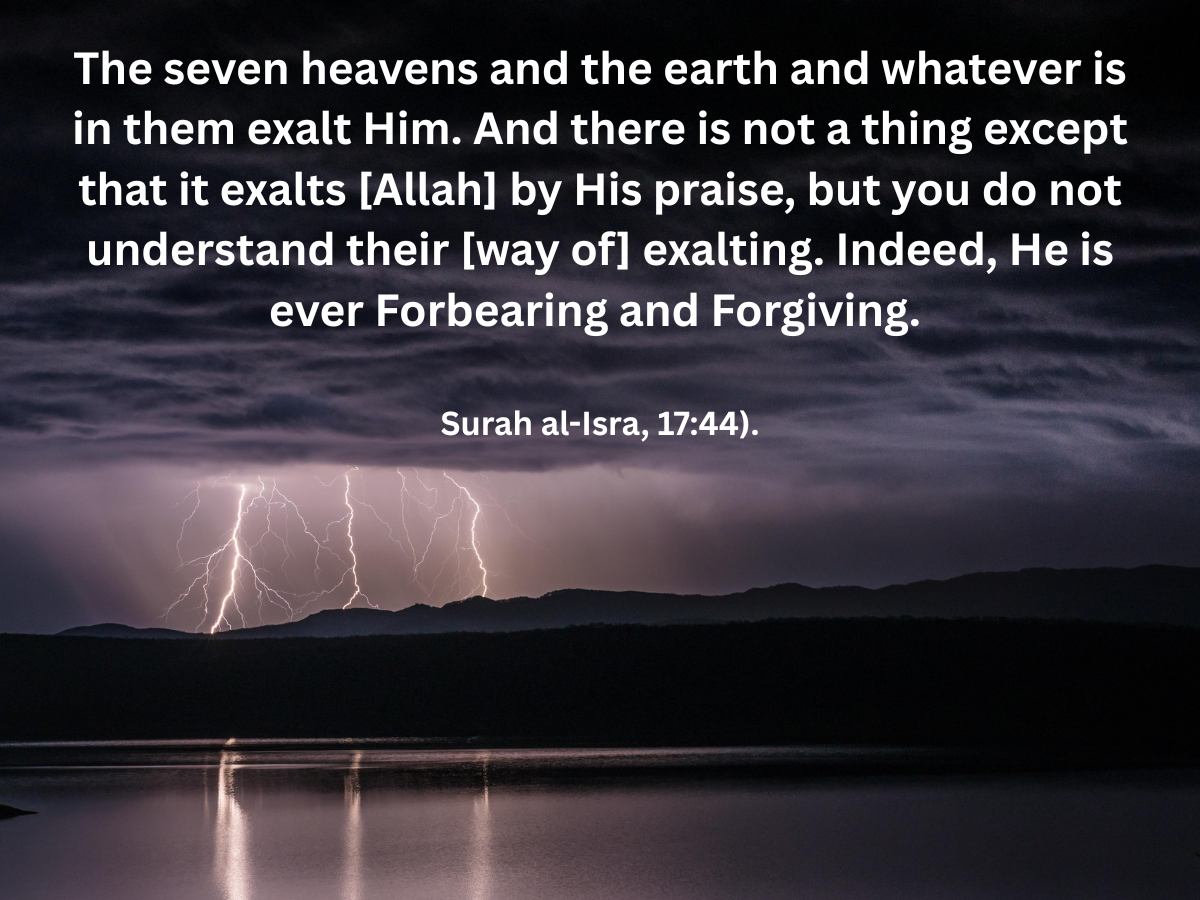
The seven heavens and the earth and whatever is in them exalt Him. And there is not a thing except that it exalts [Allah] by His praise, but you do not understand their [way of] exalting. Indeed, He is ever Forbearing and Forgiving. (Surah al-Isra, 17:44).
The thunder is among those things whose tasbeeh we can perceive in a way we hear its sound, and that sound is part of its praise. When Allah informs us that the thunder glorifies His praise, it means that even those things which seem terrifying or harsh to us are, in reality, obedient servants of Allah. They do only what He commands. Their sound is their worship.
So when the believer hears it, he should not feel a sense of chaos or randomness. Rather, he should feel a sense of order, a cosmic order, where everything, from the smallest atom to the mightiest thunderclap, is in submission to Allah. This explained that thunder is a creation from the creation of Allah, and its sound is a form of praise and obedience to Him.
What is the Dua Upon Hearing Thunder By Our Prophet
In Islam, we do not invent our own forms of worship. We do not guess at what pleases Allah. We follow. We follow the one whom Allah sent as a mercy to the worlds, the one whose character was the Quran, whose every action was a lesson, whose every word in moments of calm and moments of intensity was a guidance for us until the end of time.
The strongest and most authentic narration regarding this dua upon hearing thunder comes from Abdullah ibn az-Zubayr (may Allah be pleased with him), the noble Companion and the son of Zubayr ibn al-Awwam and Asma bint Abi Bakr. He was a man of immense piety and knowledge, raised in the household of the Prophet’s closest companions.
It was said that when our Prophet ﷺ heard the sound of thunder, he would stop speaking and would say the following dua upon hearing thunder:
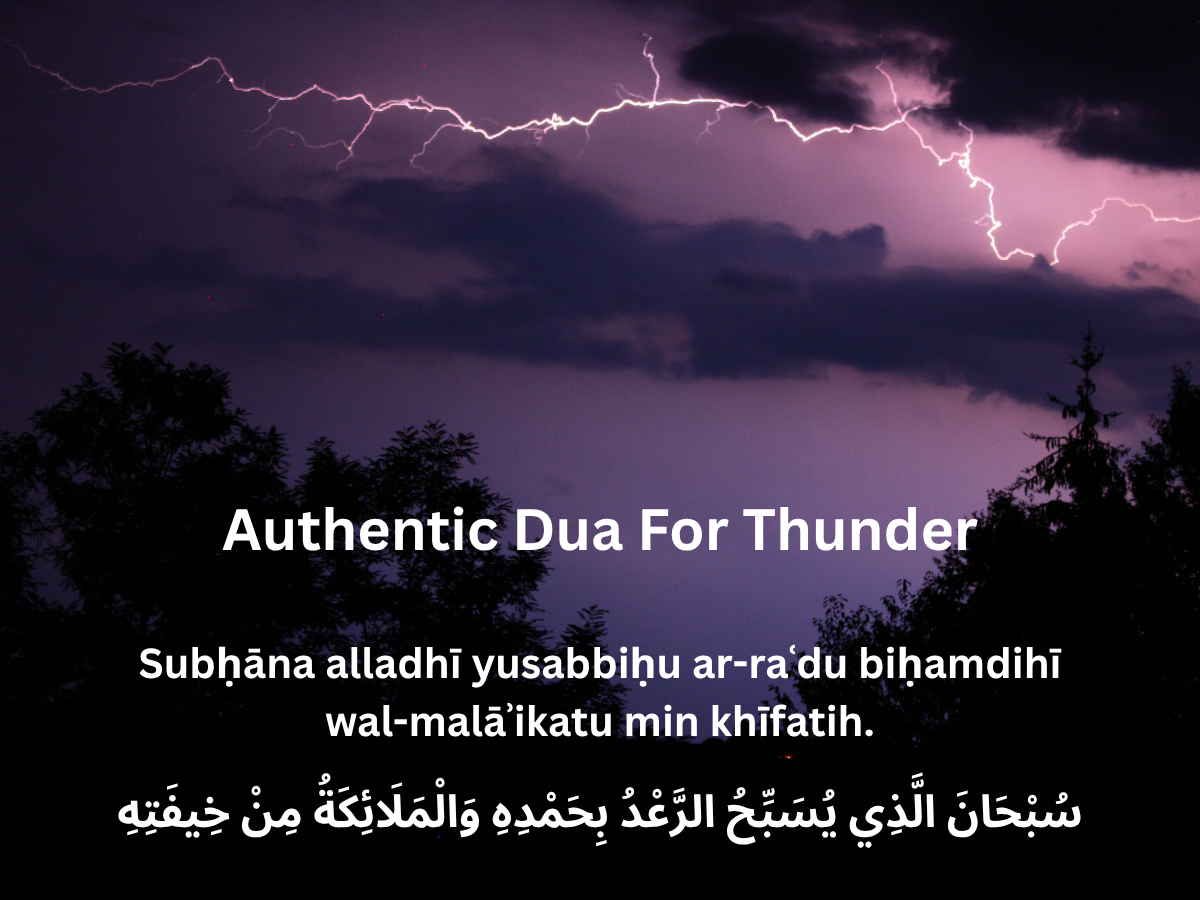
Authentic Dua For Thunder
Arabic:
سُبْحَانَ الَّذِي يُسَبِّحُ الرَّعْدُ بِحَمْدِهِ وَالْمَلَائِكَةُ مِنْ خِيفَتِهِ
Transliteration:
Subḥāna alladhī yusabbiḥu ar-raʿdu biḥamdihī wal-malāʾikatu min khīfatih.
English Translation:
“Glory be to the One whom the thunder glorifies with His praise, and the angels [glorify Him] out of fear of Him.”
Is there any authentic dua upon hearing thunder?
However, there is another dua upon hearing thunder that has been narrated in the traditions but most scholars said that the hadith is weak.
Arabic:
اللَّهُمَّ لاَ تَقْتُلْنَا بِغَضَبِكَ وَلاَ تُهْلِكْنَا بِعَذَابِكَ وَعَافِنَا قَبْلَ ذَلِكَ
Transliteration:
Allāhumma lā taqtulnā bi-ghaḍabika wa lā tuhliknā bi-ʿadhābika wa ʿāfinā qabla dhālik.
English Translation:
“O Allah, do not kill us with Your wrath, and do not destroy us with Your punishment, and grant us well-being before that.”
However, there is an important nuance, the chain of narration for this specific wording has been classified by many scholars as da’if (weak). Imam al-Tirmidhi himself, after recording the hadith, noted that there is some discussion about its chain. Imam an-Nawawi (may Allah have mercy on him) mentioned in his Kitab al-Adhkar that while this narration is known, its chain is not strong.
The Scholarly Position on Weak Hadith in Supplications
There is a well-established principle among the scholars of Islam regarding weak narrations when it comes to fada’il al-a’mal, matters of virtuous deeds, encouragement to good, and supplications.
The majority of scholars, including the great Imams Ahmad ibn Hanbal, an-Nawawi, Ibn Hajar, and others, held that it is permissible to act upon weak hadiths in matters of targhib wa tarhib (encouragement and warning) and in adhkar (remembrances and supplications), provided that the weakness is not severe and that the meaning is not contradictory to established texts.
Dear reader, by now you can see that thunder is not just a sound in the sky, it is a sign from our Lord. Every time you hear that powerful roar, you should be reminded of Allah’s greatness, His control over the universe, and your return to Him, and say the recommended and authentic dua upon hearing thunder that the Prophet ﷺ used to say. We should never forget the morning adhkar and evening adhkar.
We ask Allah to protect us from His anger and save us from Your punishment. Grant us hearts that remember Him in every moment, in ease and in fear, in silence and in storms. Aameen
