


Assalaamu alaikum warahmatullahi wabarakaatuhu my Muslim brother and sisters. There’s no doubt that during Ramadan, we eagerly await the moment of iftar, that blessed time when we break our fast after a long day of obedience and worship. But beyond the joy of quenching thirst and satisfying hunger, there lies a great moment where duas are accepted and it’s sunnah to say our dua for breaking fast
The real issue is that we see people saying inauthentic dua when breaking fast in Ramadan, ascribing it to our Prophet. People don’t really know the authentic dua for breaking fast, and this calls for attention. Whenever a Sunnah comes from our Prophet, it should be done as he did it, and the dua for breaking fast is not an exception. In shaa Allah, we are going to clarify the authentic dua when breaking fast in this article today.
Importance of making dua when breaking Fast in Ramadan
The Prophet Muhammad (ﷺ) described Iftar (the time of breaking fast) as one of the happiest moments for a fasting person because it signifies the completion of an essential act of worship that Allah obligated on us. He also said that the time of Iftar is one of the best times when one’s prayers are readily accepted. making it essential to utilize this blessed period for heartfelt supplications. The prophet said ﷺ:
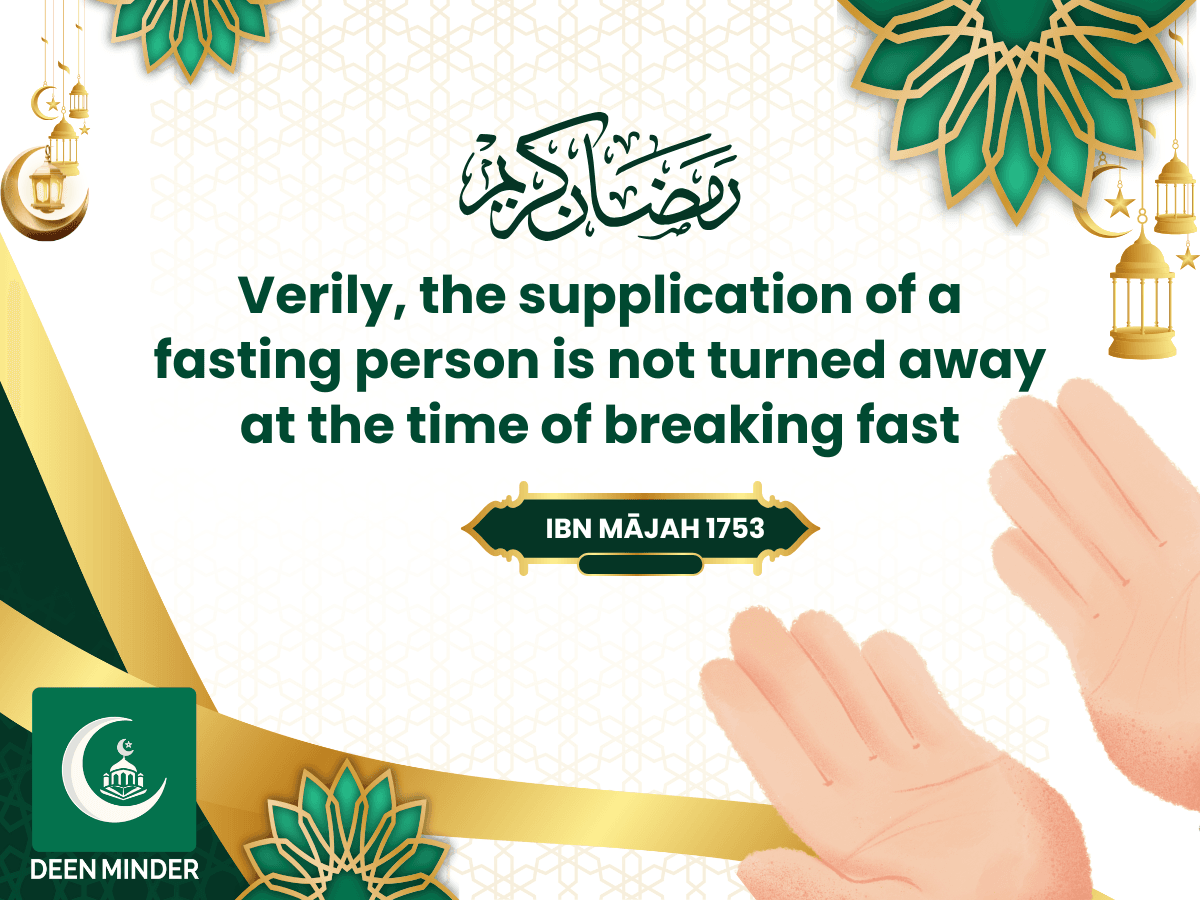
Verily, the supplication of a fasting person is not turned away at the time of breaking fast (Sunan Ibn Mājah 1753)
The time of Iftar is a time when Allah showers His mercy upon His servants, and their duas are more likely to be answered. The spiritual benefits of iftar extend beyond nourishment, providing an opportunity to ask Allah one’s wants or needs through sincere supplications. Having known the benefit of this great moment, won’t you make the best use of it?
What Is The Authentic Dua For Breaking Fast?
The prescribed authentic dua for breaking fast is the one that comes from our Prophet ﷺ from Ibn Umar who reported that: The Messenger of Allah, peace and blessings be upon him, would say upon breaking the fast:
Arabic Dua For Breaking Fast:
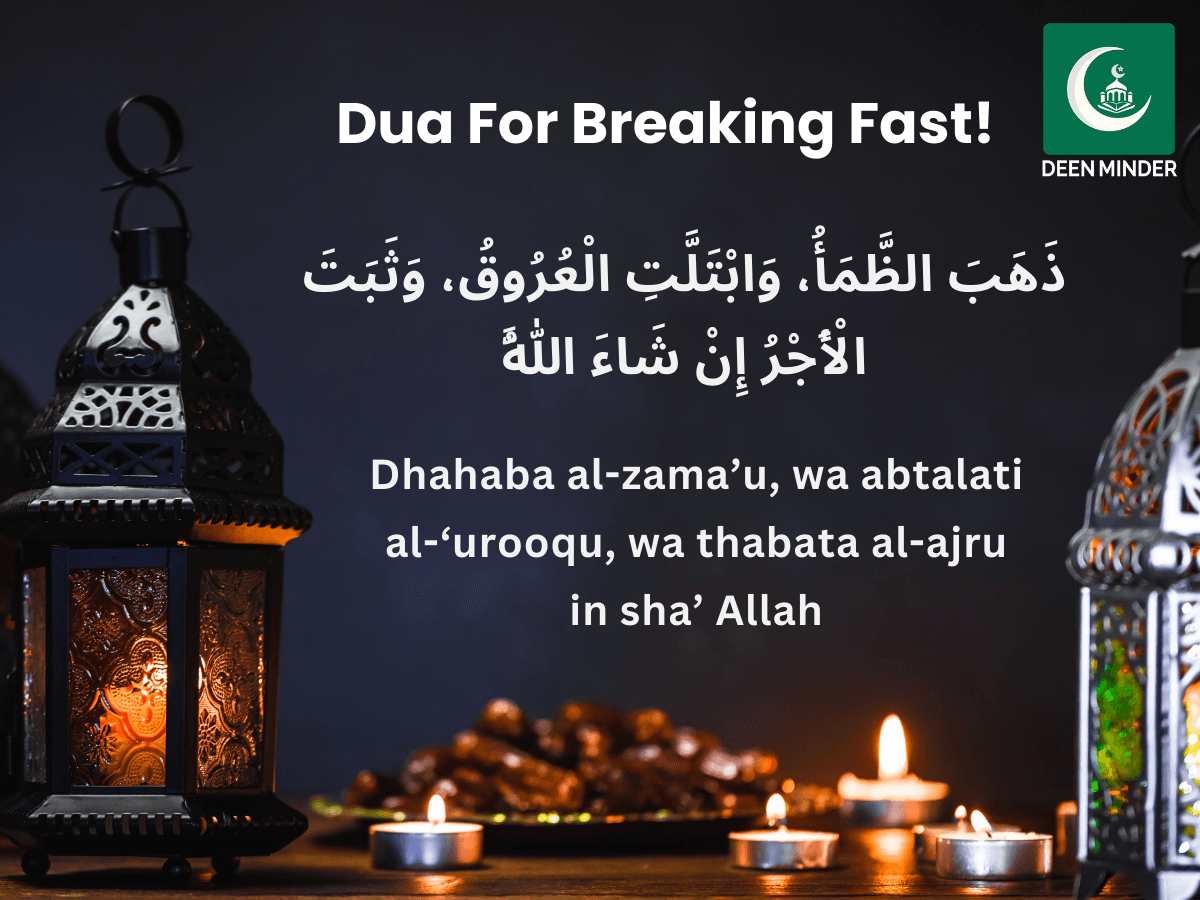
ذَهَبَ الظَّمَأُ وَابْتَلَّتِ الْعُرُوقُ وَثَبَتَ الأَجْرُ إِنْ شَاءَ اللَّهُ
Transliteration For Dua For Breaking Fast:
Dhahaba al-zama’u wabtallati al-‘uruqu wa thabata al-ajru in shaa Allah
English Meaning For Dua When Breaking Fast:
“The thirst is gone, the veins are moistened, and the reward is confirmed, if Allah wills.”
Sunan Abi Dawud, 2357
This is the only authentic dua for breaking fast. It is important for us to do this particular dua for us to have benefit and utmost reward, as Islam is a religion that is based on evidence. There is no doubt that a lot of the breaking fast dua (iftar) that people make have no basis from Rasulullah.
Can I Add My Personal Dua When Breaking Fast?
Yes, it is recommended to make dua after breaking fast because it is among the best moments when one’s supplications are readily accepted. It is more advisable that we say the prescribed authentic dua after breaking the fast that we mentioned above first, and then follow it with our own personal dua (Dua for needs or wants). Evidence of this is from the sunnah, which Abdullah ibn Amr reported:
The Messenger of Allah, peace and blessings be upon him, said, “Verily, the supplication of a fasting person is not turned away at the time of breaking fast .”
Abdullah would say when breaking fast, “O Allah, I ask You by You mercy, which encompasses all things, to forgive me.”
اللَّهُمَّ إِنِّي أَسْأَلُكَ بِرَحْمَتِكَ الَّتِي وَسِعَتْ كُلَّ شَيْءٍ أَنْ تَغْفِرَ لِي
(Sunan Ibn Mājah 1753)
The Iftar time is a moment of acceptance, where Allah is especially responsive to the prayers of His servants. Therefore, after saying the authentic dua for breaking fast, you can ask Allah for anything—whether it’s guidance, forgiveness, good health, sustenance, or success in this life and the Hereafter.
Alternative Duas for Breaking Fast (Are They Authentic?)
There are several duas that are commonly shared for breaking fast, but not all of them are authentic. Some Muslims recite duas that have been passed down culturally without verifying their authenticity from hadith sources. While certain duas are well-known, only those that have a strong chain of narration should be relied upon.
The most authentic and widely recognized dua for breaking fast is the one narrated by Abdullah ibn Umar (may Allah be pleased with him). The Prophet Muhammad (ﷺ) said:
“ذَهَبَ الظَّمَأُ، وَابْتَلَّتِ الْعُرُوقُ، وَثَبَتَ الْأَجْرُ إِنْ شَاءَ اللَّهُ.”
“Dhahaba al-zama’u, wa abtalati al-‘urooqu, wa thabata al-ajru in sha’ Allah.”
“Thirst is gone, the veins are moistened, and the reward is confirmed, if Allah wills.”
(Abu Dawud 2/306)
However, you may have come across other duas recited by others when breaking fast in Ramadan. Kindly stick to the authentic dua when breaking fast.
Avoid This Dua For Breaking Fast
اللهم إني لك صمت، وبك آمنت، وعليك توكلت، وعلى رزقك أفطرت
Allahumma inni laka sumtu, wa bika aamantu, wa alayka tawakkaltu, wa ala rizq-ika-aftartu.
“O Allah! I have fasted for You, I believe in You, I put my trust in You, and with Your provision, I break my fast.”
This dua is commonly recited by many when breaking the fast, but it does not have an authentic hadith reference from the Prophet Muhammad. It is often attributed to Islamic tradition rather than a rigorously authenticated hadith. This particular dua has other variations, yet they are all inauthentic.
While this dua is often shared and its meaning is good, its authenticity is debated among scholars. Some consider it weak (Da’if), while others consider it a good practice. It’s important to prioritize the most authentic supplications to ensure your worship aligns with the Sunnah. Using weak or fabricated duas can dilute the purity of your worship, so it’s crucial to stick to what is authentically narrated.
Reason Why Only Authentic Duas Should Be Recited
Using the authentic dua for breaking Fast is a matter of following the Sunnah correctly. The Prophet Muhammad (ﷺ) warned against adding to or altering the religion. He said:
“Whoever introduces something into this matter of ours that is not part of it will have it rejected.”
(Sahih al-Bukhari)
The Prophet (ﷺ) warned against attributing false statements to him, stating:
“Whoever tells a lie against me deliberately, let him take his place in Hell.” (Sahih Bukhari 109).
By sticking to authentic dua for breaking fast, we ensure that our worship is sincere and in line with the teachings of the Prophet (ﷺ) and not introducing innovations (bid’ah) into worship. It’s not just about the words we say but about the intention and authenticity behind them. Since we have learned the authentic dua when breaking fast, that should suffice for us.
Let us revive this Sunnah and make our iftar moments a time of gratitude and sincere prayer. As we strive to follow the Sunnah and deepen our connection with Allah, let’s make the most of every moment, especially during Ramadan. May Allah accept our fasts, answer our duas, and grant us success in this life and the next.
May Allah accept our fasts, answer our duas, and grant us His mercy and forgiveness. Aameen.
